

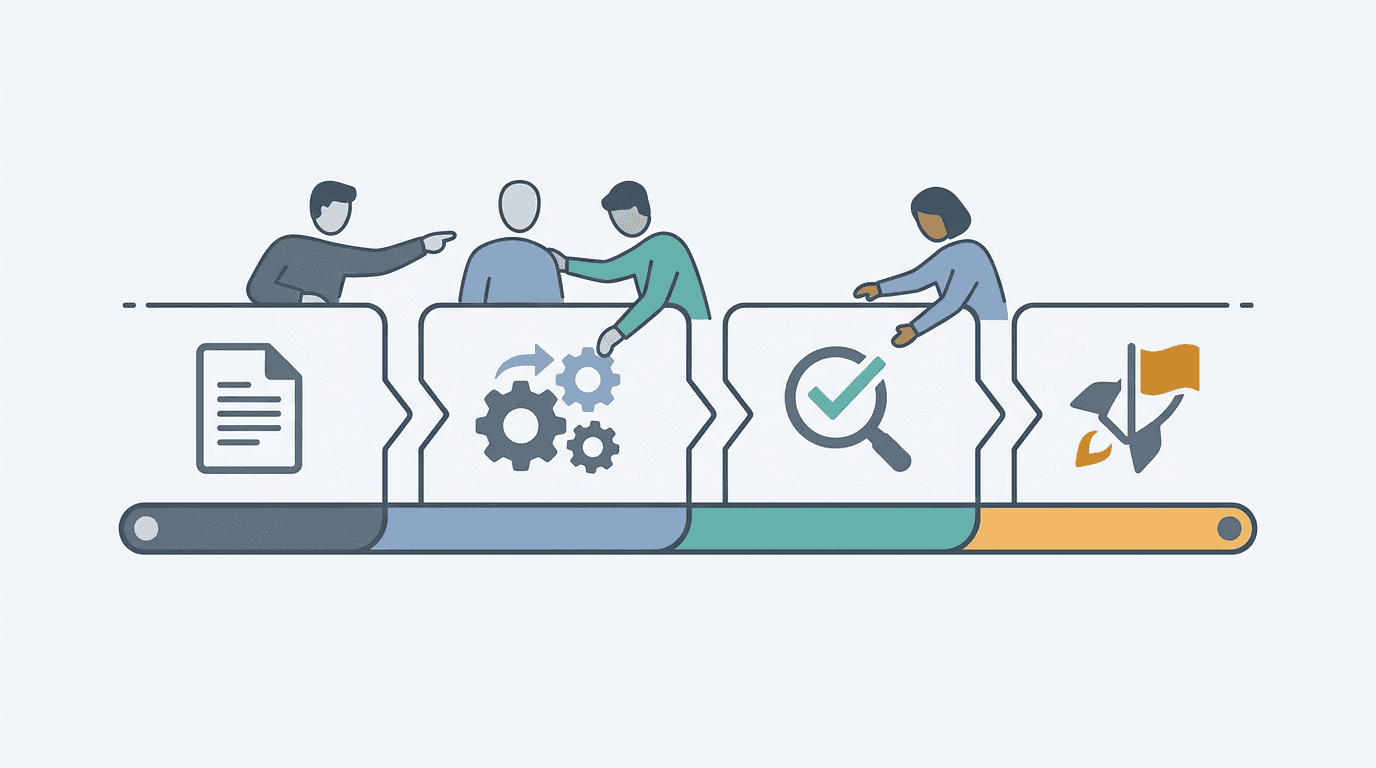
Software engineering had a moment, about fifteen years ago, when it realized that building code and shipping code were different disciplines. Writing a feature was one thing. Getting it reliably into production — tested, deployed, monitored, rolled back if necessary — was another thing entirely.
That realization created DevOps. And it transformed how software teams work.
Market research is having the same moment right now.
The work behind the work
Every research project involves two categories of effort:
Research work: Designing the study, choosing the methodology, interpreting findings, advising stakeholders. This is what researchers are trained for and what they're evaluated on.
Operational work: Programming surveys, managing vendor timelines, deploying to platforms, running link tests, coordinating fieldwork, processing data files, formatting deliverables. This is what keeps the project moving but doesn't require research expertise.
In most organizations, the same people do both. A senior researcher who should be designing a segmentation study spends half their week programming trackers, testing links, and exporting data.
This is like asking a software architect to manually deploy every build. Technically possible. Strategically wasteful.
What ResOps actually covers
Research Operations — ResOps — is the discipline of managing the operational infrastructure of a research function. It includes:
- Survey programming and deployment: Translating questionnaire specs into platform-specific surveys, deploying to Decipher, Qualtrics, ConfirmIt, or other platforms
- Quality assurance: Link testing, logic validation, data integrity checks before and during fielding
- Vendor and panel management: Coordinating with sample providers, managing quotas, monitoring field progress
- Platform administration: Managing user access, templates, libraries, and configurations across survey platforms
- Data processing: Cleaning, weighting, formatting, and delivering data files
- Tool and workflow management: Evaluating, implementing, and maintaining the technology stack
Each of these functions requires skill and attention. None of them require a PhD in consumer psychology.
Why it matters now
Three forces are converging to make ResOps urgent:
1. Research volume is increasing faster than headcount
The GRIT Business & Innovation Report consistently shows that insights teams are expected to support more projects without proportional increases in staff. AI has accelerated this — stakeholders see faster turnaround on some tasks and assume the entire pipeline has sped up.
Without a dedicated operational function, the extra volume lands on researchers, who absorb it by working longer hours on lower-value tasks.
2. Platform complexity is growing
A decade ago, most teams used one survey platform. Now it's common to support two, three, or four — each with its own scripting model, deployment process, and quirks. Add in data visualization tools, panel management systems, and client-specific requirements, and the operational surface area has expanded dramatically.
Managing this complexity is a full-time job. Treating it as a side responsibility of the research team guarantees inefficiency.
3. AI is automating the operational layer — but someone still needs to manage it
As AI tools handle more of the mechanical work — programming, validation, deployment — the operational function doesn't disappear. It transforms. Instead of doing the work manually, ResOps teams configure, supervise, and optimize the automated systems.
This mirrors the DevOps evolution exactly. Automation didn't eliminate operations teams. It elevated them from manual execution to system design.
What high-performing ResOps looks like
The research teams that treat operations as a strategic function share a few characteristics:
Dedicated roles. Whether it's a "Research Operations Manager," "Survey Operations Lead," or "Technical Research Specialist," someone owns the operational pipeline. It's not an afterthought tacked onto a researcher's job description.
Standardized workflows. Programming, QA, deployment, and data processing follow documented procedures. New team members can onboard without oral tradition.
Platform-agnostic thinking. The operational team thinks in terms of survey logic and research design, not platform syntax. They can deploy the same study to Decipher or Qualtrics without starting over.
Metrics. Time to field. Error rates. Revision cycles. Cost per study. If you're not measuring operational performance, you can't improve it.
Automation where it counts. The mechanical, high-volume, error-prone tasks are automated. Human effort is reserved for judgment calls, edge cases, and quality review.
The parallel with DevOps
The DevOps analogy isn't cosmetic. The patterns are strikingly similar:
| DevOps | ResOps |
|---|---|
| CI/CD pipelines | Automated survey programming and deployment |
| Infrastructure as code | Questionnaire as source of truth |
| Automated testing | Automated link testing and logic validation |
| Monitoring and alerting | Field monitoring and data quality checks |
| Multi-cloud deployment | Multi-platform survey deployment |
| Rollback capability | Survey versioning and revision tracking |
The lesson from DevOps is clear: when you treat operations as engineering, quality and speed both improve. When you treat it as overhead, you get fragile systems and burned-out teams.
Getting started
You don't need to reorganize your team overnight. Start with three things:
-
Audit where researcher time goes. Track how much time your senior researchers spend on operational tasks. The number is usually shocking.
-
Identify the highest-volume mechanical tasks. Survey programming, link testing, and data formatting are almost always at the top.
-
Evaluate automation for those tasks specifically. Don't boil the ocean. Automate the one thing that costs you the most time and has the most predictable structure.
The goal isn't to build a research factory. It's to free your researchers to do research — and give your operations the rigor and investment they deserve.
Questra automates the survey programming layer of research operations — from questionnaire upload to validated, platform-ready output. If your researchers are spending more time on programming than insights, we should talk.